
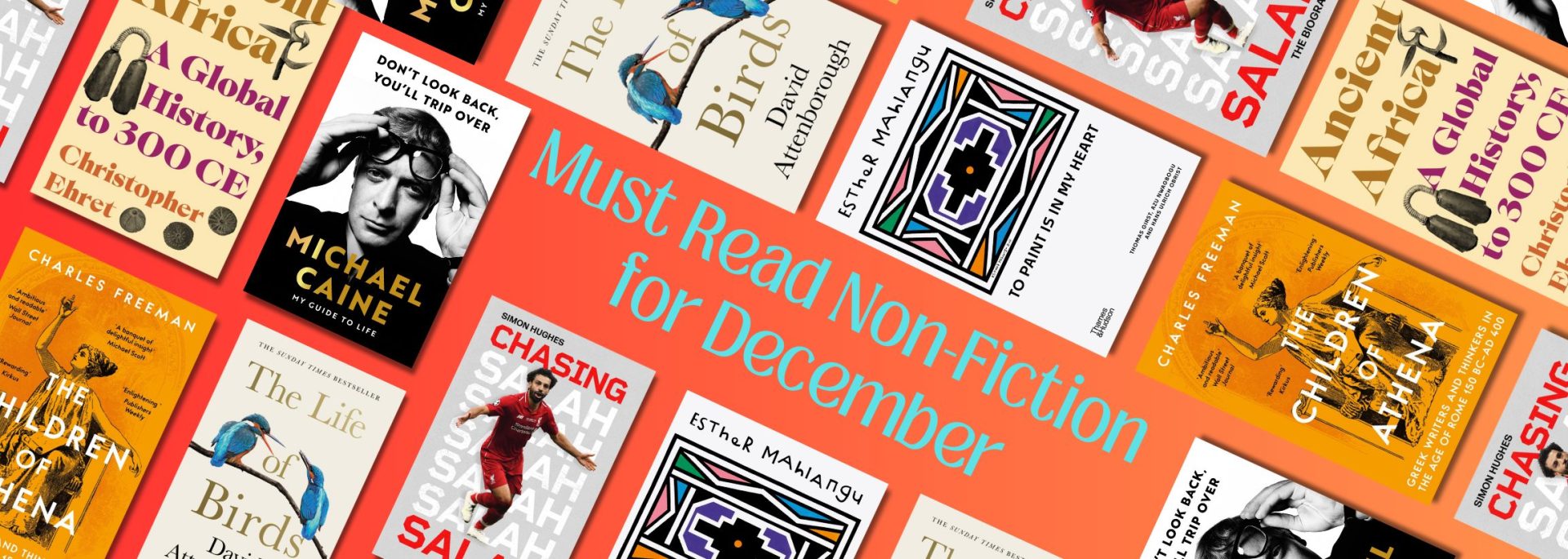
From sporty biographies and ancient history, to art and stoic self-help, check out our selection of the Must Read Non-Fiction titles for December 2024.
Must Read Non-Fiction Books for December 2024
Esther Mahlangu: To Paint Is In My Heart
9780500028124 | Thames & Hudson | HB
Thomas Girst & Azu Nwagbogu

A captivating exploration of the life and work of the iconic South African artist Esther Mahlangu, one of the great innovators of Pan-African Contemporary Art.
‘Esther Mahlangu is one of the most important artists of our time who continues to inspire artists all over the world. Mahlangu is a visionary who brings art into society’ Hans Ulrich Obrist
Esther Mahlangu (b. 1935) is globally acclaimed for her bright and bold abstract paintings that are rooted in South African Ndbele art. She was a disruptor from an early age, becoming the first person to reimagine her visual heritage, historically used for decorating houses, on painting media such as canvas. Mahlangu is one of the most influential artists of Pan-African Contemporary Art.
Esther Mahlangu: To Paint is in My Heart celebrates Mahlangu’s remarkable journey as a pioneer and innovator of contemporary African art, whose vibrant and distinctive paintings have captured the hearts of many worldwide. Through a series of interviews with Mahlangu conducted by Thomas Girst, Azu Nwagbogu and Hans Ulrich Obrist, readers will gain insight into her creative process, inspiration, and the cultural significance of her work – in the artist’s own words.
With a preface by Nontobeko Ntombela, the curator of Mahlangu’s major 2024 travelling retrospective, this book presents stunning visuals and engaging narratives, offering an inspiring experience to the reader.
Don’t Look Back, You’ll Trip Over
9781399739986 | Hodder & Stoughton | TPB
Michael Caine

The Hollywood screen legend brings his wit, insight, entertaining stories and wisdom to answer questions about every aspect of his long life – inspiring us all to Be More Michael Caine.
I’m always asked questions – by fans, by other actors and friends, by my grandchildren. They want to know how I’ve lasted so long, how I handle fame, why I chose to do some of my films, which films and actors I like best and so forth.
They also want to know what makes me tick, what makes me get up in the morning in my 90s, and whether I’ll ever retire. (The answer to that one is “No!”)
Over a long life, I’ve learnt a lot and had the opportunity to reflect. I’ve seen a new generation grow up, among them my own grandchildren, facing the world with all its challenges and problems.
I hope they’ll find Don’t Look Back, You’ll Trip Over: My Guide to Life helps them to be optimistic – and shows that anyone can blow the bloody doors off.
An iconic book, from one of our best-loved actors: this is Michael Caine at his very best.
States of Play
9781399619417 | Orion | TPB
Miguel Delaney

The definitive account of how sportswashing and capitalism have taken over modern football
As the 2022 World Cup in Qatar drew to a close, there was a bitter undercurrent to Argentina’s triumph. Throughout the tournament, numerous allegations of sportswashing and financial misconduct had been made against the state of Qatar, moving what had previously been a smaller conversation into the worldwide spotlight. The question had been asked, who really owns and runs football?
Journeying from Abu Dhabi to Newcastle, and onto London, Paris, Moscow and New York in search of the answers, Miguel Delaney follows the threads that surround the allegations of sportswashing and misconduct in the beautiful game. The result is an exploration of how European football clubs have been bought by some of the world’s wealthiest businessmen and state-backed corporations.
From Neymar’s £198 million transfer to Paris Saint-Germain and Abu Dhabi’s construction empire in Manchester to failed Financial Fair Play constraints and the dawn of the European Super League, Miguel draws on exclusive interviews and unprecedented access to key stakeholders to produce an all-encompassing exposé of modern footballs highest echelons.
Authoritative, riveting and eye-opening, this book reveals how football has been taken away from the fans and is now a tool for the world’s elite.
The Museum of Lost and Fragile Things
9781911648680 | Indigo Press | PB
Suzanne Joinson

Suzanne Joinson grew up in a 1980s council estate in Crewe, where her parents were followers of The Divine Light Mission cult. This clash of class and counterculture destroyed her family, leaving a legacy of turmoil and poverty.
Years later, she attempts to reclaim what she’s lost and piece together the impact of a childhood infused with esoteric yoga practices, psychedelic encounters, and meditation techniques. She acquires replicas of beloved objects that had to be destroyed in regular purges in the hope of restoring family ties.
The Museum of Lost and Fragile Things explores the realm of mother daughter relationships and inherited trauma, in a moving, delicately woven account of coming to terms with a complicated past.
Stoic in Love
9781761500404 | Murdoch | PB
Annie Lawson

Stoic in Love uses the ancient wisdom of Stoic philosophy to help find love, build relationships and determine whether to stay or go when things become predictable or go pear-shaped.
How can a philosophy not normally associated with matters of the heart help us make our relationships more fulfilling, fire up partnerships that are treading water, get the best from dating online and in real life, and gracefully exit when things turn sour? Stoicism provides a framework for focusing on what matters, providing space before you react and making a decision when confronted with difficulty. Whether it’s dating a person wearing horns and a kaftan, navigating a relationship where blobs of toothpaste are left smeared in the bathroom sink or being dumped via text with just one word – ‘enough’.
This book encompasses anecdotes from the dating, relationship and separation frontlines. From practical wisdom on how to navigate the world of dating, to insights to making relationships better and more enduring, to strategies for breaking up well. Stoicism reminds us that the world is all about change and to focus on things we can control such as our thoughts, behaviours and actions. And to not worry so much about things we cannot control.
Didion & Babitz
9781805463993 | Atlantic | TPB
Lili Anolik

An outrageously provocative and profoundly moving new work on the complicated relationship between Joan Didion and her fellow literary titan, Eve Babitz.
Eve Babitz died on December 17, 2021. Found in the wrack, ruin and filth of her apartment, a stack of boxes packed by her mother decades before. Inside, a lost world, centred on a two-story rental in a down-at heel section of Hollywood in the sixties and seventies. 7406 Franklin Avenue, where writers and artists mixed with movie stars, rock ‘n’ rollers and drugs.
Franklin Avenue was the making of one great American writer: Joan Didion, a mystery behind her dark glasses and cool expression, her marriage to John Gregory Dunne as tortured as it was enduring. It was also the breaking and then the remaking – and thus the true making – of another great American writer: Eve Babitz, goddaughter of Igor Stravinsky, nude of Marcel Duchamp, consort of Jim Morrison (and many, many others), a woman who burned so hot she finally almost burned herself alive. Didion and Babitz formed a complicated alliance, a friendship that went bad, amity turning to enmity.
With deftness and skill, journalist Lili Anolik uses Babitz, Babitz’s brilliance of observation, Babitz’s incisive intelligence and, most of all, Babitz’s diary-like letters – letters found in those sealed boxes, letters so intimate you don’t read them so much as breathe them – as the key to unlocking Didion.
Ancient Africa
9780691244860 | UPG | TPB
Christopher Ehret

A panoramic narrative that places ancient Africa on the stage of world history
This book brings together archaeological and linguistic evidence to provide a sweeping global history of ancient Africa, tracing how the continent played an important role in the technological, agricultural, and economic transitions of world civilization. Christopher Ehret takes readers from the close of the last Ice Age some ten thousand years ago, when a changing climate allowed for the transition from hunting and gathering to the cultivation of crops and raising of livestock, to the rise of kingdoms and empires in the first centuries of the common era.
Ehret takes up the problem of how we discuss Africa in the context of global history, combining results of multiple disciplines. He sheds light on the rich history of technological innovation by African societies— from advances in ceramics to cotton weaving and iron smelting— highlighting the important contributions of women as inventors and innovators. He shows how Africa helped to usher in an age of agricultural exchange, exporting essential crops as well as new agricultural methods into other regions, and how African traders and merchants led a commercial revolution spanning diverse regions and cultures. Ehret lays out the deeply African foundations of ancient Egyptian culture, beliefs, and institutions and discusses early Christianity in Africa.
A monumental achievement by one of today’s eminent scholars, Ancient Africa offers vital new perspectives on our shared past, explaining why we need to reshape our historical frameworks for understanding the ancient world as a whole.
Genesis
9781399819114 | John Murray | HB
Henry Kissinger

In his final book, the late Henry Kissinger joins forces with two leading technologists to mount a profound exploration of the epochal challenges and opportunities presented by the revolution in Artificial Intelligence.
As it absorbs data, gains agency, and intermediates between humans and reality, AI (Artificial Intelligence) will help us to address enormous crises, from climate change to geopolitical conflicts to income inequality. It might well solve some of the greatest mysteries of our universe and elevate the human spirit to unimaginable heights. But it will also pose challenges on a scale and of an intensity that we have never seen – usurping our power of independent judgment and action, testing our relationship with the divine, and perhaps even spurring a new phase in human evolution.
The last book of elder statesman Henry Kissinger, written with technologists Craig Mundie and Eric Schmidt, Genesis charts a course between blind faith and unjustified fear as it outlines an effective strategy for navigating the age of AI.
Art of Scale
9781067228842 | Tracy Macdonald | TPB
Jason Goldberg

Are you ready to scale your business but not entirely sure how? Then Jason Goldberg’s book, Art of Scale, is what you need.
Tailored for emerging market businesses in the tricky 10 to 200 headcount zone, this comprehensive guide demystifies the obstacles to scale, the path to scale, the science of scale, and the art of scale, giving you the practical toolkit you need.
Art of Scale distils centuries of collective scale-up wisdom gleaned from a deep network of seasoned scale-up leaders and coaches, plus the top 120 business growth books. It skips the theory and delivers proven principles and leadership models, actionable strategies, and immediately usable tools, from successful scale-up leaders.
The book is divided into six parts. Part 1 covers the physics of scaling a business. Parts 2 to 6 are playbooks for the five critical disciplines in the ‘Art of Scale’: Strategy, Execution, People, Money and Founder Leadership. Each part spans three to four chapters, all designed as a guide to mastering a critical scale-up practice. Chapters share key principles, downloadable tools, and curated reading recommendations for deeper mastery, all supported by real-world stories.
With over 30 free tools and 120 book summaries available online, this scaleup guide is what you need to grow with confidence and clarity, armed with the proven principles and tools you need to turn your vision into reality.
Bring On United
9780008726089 | HarperCollins | TPB
Andy Mitten

How Manchester United conquered all, by the players who won everything
The Champions League, the Club World Cup, 6 Premier League Titles, 1 FA Cup, 3 League Cups, 4 Community Shields, 1 legendary manager.
From Rio to Rome, 2000-2010
This is the story of one of the greatest eras in the history of England’s most successful club, told through the eyes of the players who made it happen. Not just the big wins, the cup finals and the trophy parades, but the half-time rows, the mad pranks, the boozy nights out and the training-ground bust-ups.
Andy Mitten has tracked down eleven of the stars from those Premier League and Champions League winning teams to open the door to both the dressing room and the boardroom at Old Trafford as the club cemented its status as the dominant force in English football.
Bring on United is an astonishingly candid and revealing insight into the workings of a relentless winning machine. More than that, it’s as lively and entertaining a sports book as you’ll ever read.
Featuring exclusive interviews with Nemanja Vidić, Ole Gunnar Solskjær, Patrice Evra, Gary Neville, Dimitar Berbatov, Jaap Stam, John O’Shea, Wes Brown, Dwight Yorke, Diego Forlán and Ryan Giggs.
The Children of Athena
9781803281964 | Bloomsbury | PB
Charles Freeman

A compelling and fascinating portrait of the continuing intellectual tradition of Greek writers and thinkers in the Age of Rome.
In 146 BC, Greece yielded to the military might of the Roman Republic; sixty years later, when Athens and other Greek city-states rebelled against Rome, the general Lucius Cornelius Sulla destroyed the city of Socrates and Plato, laying waste to the famous Academy where Aristotle had studied. However, the traditions of Greek cultural life would continue to flourish during the centuries of Roman rule that followed, in the lives and work of a distinguished array of philosophers, doctors, scientists, geographers, travellers and theologians.
Charles Freeman’s accounts of such luminaries as the physician Galen, the geographer Ptolemy and the philosopher Plotinus are interwoven with contextual ‘interludes’ that showcase a sequence of unjustly neglected and richly influential lives. Like the author’s The Awakening, The Children of Athena is a cultural history on an epic scale: the story of a rich and vibrant tradition of Greek intellectual inquiry across a period of more than five hundred years, from the second century BC to the start of the fifth century AD.
The Life of Birds
9780008638993 | HarperCollins | PB
David Attenborough

A fully updated new edition of David Attenborough’s bestselling classic.
BIRDS. 11,000 species, the most widespread of all animals: on icebergs, in the Sahara or under the sea, at home in our gardens or flying for over a year at a time. Earthbound, we can only look and listen, enjoying their lightness, freedom and richness of plumage and song.
David Attenborough has been watching and learning all his life. His classic book, now fully updated with the latest discoveries in ornithology, is a brilliant introduction to bird behaviours around the world: what they do and why they do it. He looks at each step in birds’ lives and the problems they have to solve: learning to fly; finding food; communicating; mating and caring for nests, eggs and young; migrating; facing dangers and surviving harsh conditions.
Sir David has no equal in helping others to learn and making it exciting. His curiosity and enjoyment are infectious. He shows the lifelong pleasure that birds around us offer, and how much we miss if unaware of them.
Lady Glenconner’s Picnic Papers
9781835012390 | Bedford Square | TPB
Lady Anne Glenconner

From the peaks of the Himalayas to the historic grounds of Hampton Court, there’s always a perfect spot for a picnic!
Anne Glenconner invites both old friends and new acquaintances to join her in The Picnic Papers. Featuring contributions from Bryan Adams, Graham Norton, Lorraine, Rupert Everett, Tina Brown, Freya Stark and many more, they explore the curious British obsession with dining alfresco, despite our famously unpredictable weather.
Picnics, it turns out, spark strong opinions. HRH Princess Margaret insisted on having hers at a proper table, while the indefatigable John Julius Norwich enjoyed 147 picnics over seven weeks in the Sahara. In stark contrast, writer James Lees-Milne simply loathed them.
Brimming with extraordinary tales and a few nostalgic recipes (though this is not a recipe book!) Lady Glenconner’s The Picnic Papers is an invitation to a delightful feast of memories and culinary delights.
Rewilding Africa
9781472145758 | Little Brown | BPB
Grant Fowlds & Graham Spence

Conservationist Grant Fowlds lives to save and protect Africa’s rhinos, elephants and other iconic wildlife, to preserve their habitats, to increase their range and bring back the animals where they have been decimated by decades of war, as in Angola, Mozambique and the Democratic Republic of the Congo.
This vivid account of his work tells of a fellow conservationist tragically killed by the elephants he was seeking to save and a face-off with poachers, impoverished rural people exploited by rapacious local businessmen.
Fowlds describes the impact of the Covid pandemic on conservation efforts, the vital wildlife tourism that sustains these and rural communities; and tells of conservationists’ efforts to support people through the crisis. Lockdowns may have brought a welcome lull in rhino and other poaching, but also brought precious tourism to a standstill.
He shows how the pandemic has highlighted the danger to the world of the illicit trade in endangered wildlife, some of it sold in ‘wet markets’, where pathogens incubate and spread.
He describes a restoration project of apartheid-era, ex-South African soldiers seeking to make reparations in Angola, engulfed for many years in a profoundly damaging civil war, which drew in outside forces, from Cuba, Russia and South Africa, with a catastophic impact on that country’s wildlife.
Those who fund conservation, whether in the US, Zambia or South Africa itself, are of vital importance to efforts to conserve and rewild: some supposed angel-investors turn out to be not what they had appeared, some are thwarted in their efforts, but others are open-hearted and generous in the extreme, which makes their sudden, unexpected death an even greater tragedy. A passionate desire to conserve nature has also brought conservationists previously active in far-off Venezuela to southern Africa.
Fowlds describes fraught meetings to negotiate the coexistence of wildlife and rural communities. There are vivid accounts of the skilled and dangerous work of using helicopters to keep wildebeest, carrying disease, and cattle apart, and to keep elephants from damaging communal land and eating crops such as sugar cane.
He tells of a project to restore Africa’s previously vast herds of elephants, particularly the famed ‘tuskers’, with their unusually large tusks, once prized and hunted almost to extinction. The range expansion that this entails is key to enabling Africa’s iconic wildlife to survive, to preserving its wilderness and, in turn, helping humankind to survive.
There is a heartening look at conservation efforts in Mozambique, a country scarred by years of war, which are starting to bear fruit, though just as a new ISIS insurgency creates havoc in the north of the country.
What will humanity’s relationship with nature be post-pandemic? Will we have begun to learn that by conserving iconic wildlife and their habitats we help to preserve and restore precious pockets of wilderness, which are so vital not only the survival of wildlife, but to our own survival on our one precious planet.
Chasing Salah
9781408721162 | Little Brown | TPB
Simon Hughes

The definitive biography of Liverpool legend and most famous Egyptian footballer in the history of the sport, Mohamed Salah.
Salah’s achievements are, in many ways, unparalleled. A Champions League and Premier League winner, he is a two-time African Footballer of the Year who straddles two worlds.
The first is the continent he comes from, as well as the Islamic Middle East. The second is Europe, where he has broken all sorts of goalscoring records at Liverpool, helping him to become the most identifiable Arabic player on the planet.
And yet, his consistent success on the pitch, record-breaking playing, team victories and popular persona, little is known about the Liverpool forward, or the competing forces around him. That is, until now.
Award-winning football journalist and author Simon Hughes expertly pieces together a fascinating portrait of this enigmatic football icon. From his relationships with his teammates to what motivates him; from how the events of the past decade in Egypt have impacted his life, to what’s next in his career – Chasing Salah reveals all.